Blog
Gameable Grimoires #2: The Lesser Key of Solomon
Continuing my survey of Western Esotericism from a TTRPG perspective, I will take a look at the infamous Lesser Key of Solomon (aka. the Lemegeton), a cornerstone of Solomonic magic from the 17th century. Specifically, we'll be examining the Ars Goetia. This treatise, one of five in the Lemegeton, is devoted to the evocation of 72 infernal spirits of various powers.
Introduction to Solomonic Magic
The origins of the Ars Goetia, and Solomonic Magic as a whole, are ancient and unclear. Both the Papyri Graecae Magicae and the Dead Sea Scrolls already portray King Solomon as an occult practitioner. These myths and legends culminate in the Testament of Solomon, detailing the story of his binding and exorcism of demons. The text provides a thorough catalogue of demons, which can, in some sense, be traced back to the Book of Enoch, but it isn't intended to be a useable handbook of magic.
The first such text is the Hygromancy of Solomon, which presents many ideas later found in the Lesser Key. Then, this eastern, Byzantine tradition is supplemented by Latin, western esoteric practices, such as the Ars Notoria ritual, in the late Middle Ages. This produces works like the Heptameron or the Munich Manual of Demonic Magic, which already closely resemble parts of the Lemegeton.
What this complex history of influences produces is a very heterodox form of magic, which draws on a wide variety of sources and philosophies. It's no surprise then that the books that make up the Lesser Key of Solomon hardly form a coherent theory of necromancy, and are largely disconnected from one another.
Goetic practice in the Lesser Key of Solomon
The Ars Goetia as it is presented in the Lemegeton starts with a list of 72 infernal beings. Each of them is given a feudal rank, services they may provide to the exorcist, and a sigil. These attributes also have secondary implications such as which metal their seal is to be marked on, when they might be summoned, or what astrological forces they are associated with.
Example description of an infernal spirit from the Ars Goetia:
"The first principall spirit is a king ruling in ye East, called Bael. he maketh men goe Invisible, he ruleth over 66 Legions of Inferiour spirits, he appeareth in divers shapes, somtimes like a Catt, sometimes like a Toad, sometimes like a man, & sometimes in all these formes at once. he speaketh very horsly.
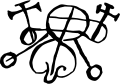
This is his Character wch is to be worne as a Lamen before him who calleth him forth, or else he will not doe you homage."
As these spirits are generally malevolent, the book advises the necromancer to prepare ample protection. Such devices include:
- a magical circle of protection around the conjurer,
- a special parchment seal that is to be worn under ones clothes to ensure the obedience of the demons summoned,
- a protective pentagonal figure placed on the breast (beside the spirit's sigil) by which the exorcist can also command demons,
- a magical ring that defends its wearer from the stinking fumes of spirits.
There's a host of other materials that make up the final apparatus. Notably, demons are summoned into a separate triangle and can be held captive in a brazen (or glass) vessel, if disobedient. This reinforces the idea that the ceremony is not without danger, and that necessary precautions have to be made on the exorcist's part.
The evocation itself is presented as mostly mechanical (i.e. results are achieved necessarily). However, numerous conjurations are provided in case spirits refuse to appear. (The unlikelihood of this circumstance is stressed repeatedly). The conjurer may first appeal to the spirit’s king, demanding that they be delegated. In the improbable case that this fails though, the demon might have to be evoked from the depths of hell where they are chained up. If even that fails, the conjurer can threaten the spirit by putting their seal in fire as a last resort. Then they are sure to appear.
How Goetia might work at the table
The necromantic practice laid out in this treatise already differs from the standard magic systems we're familiar with from TTRPGs in its conception of the origin of supernatural abilities. Goetic exorcists have no innate occult power. They merely acquire it through the help of infernal beings. In this respect, the Clerics of D&D resemble historical practice much more closely than Magic-Users do.
Apart from this apparent difference, the two theories diverge in other meaningful ways too. For instance, the fact that specific spirits provide specific services. Below is a list of a few demons with the most interesting abilities:
"The second spirit is a Duke called Agares, he is under ye power of ye East and cometh up in the form of a fair Old man riding upon a Crocodill, very mildly, carrying a goshawke on his fist. he maketh them runne that stand still, and fetcheth back ye runnawayes. he can teach all Languages or Tongues presently, he hath power also to destroy dignities, both supernaturall & Temporall; & cause Earthquakes. he was of the order of Vertues; he hath under his government 31 Legions &c: & this is [his] seale or Charecter wch is to be worne as [a] Lamen."2. Agares
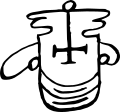
"The Third spirit is a mighty prince, being of ye same Nature as Agares, he is called Vassago, This spirit is of a good nature, & his office is to declare things past and to come; and to discover all things hidden or lost &c: he governeth 26 Legions of spirits. This is his seal."3. Vassago
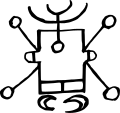
"The 14th spirit is called Leraye (or Leraje). he is a Marquize great in power shewing him selfe in ye likeness of an archer, cladd in green carring [carrying] a Bow and quiver, he causeth all great Battles & contests, & causeth ye wounds to putrifie that are [made] wth arrows by archers this belongeth to Sagittarius he governeth 30 Legions of spirits, & his seale of obediance is this."14. Leraye
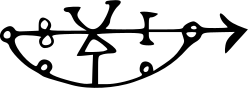
" The 23d spirit is called Aim, a great duke and strong, he appeareth in ye forme of a very handsome man in Body, [but] wth 3 heads, The first like a serpent ye second like a man wth 2 starrs in his forehead, The Third [head] is lik a Catt; he rideeth on a viper, carring a fire brand in his hand burning, whereth [wherewith] he sets Citties Castles & greate places on fire he maketh one witty [in] all manner of wayes, and giveth true answares to privy matters, he governeth 26 Legions of Infernall spirits; his seal is thus to be made, and worne as a Lamen before you."23. Aim
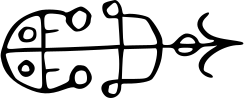
"The 38th spirit is called Halphas he is a great Earle and appeareth in ye forme of a stork, and speaketh wth a hoarse voyce; his office is to build up Towns & to furnish them wth ammunition and weapons, and to send men of warre to places appointed; he ruleth 26 Legions of spirits; his seal is Thus to be made, & worne as a Lamen &."38. Halphas
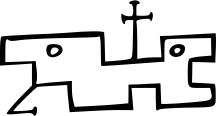
"The 41 spirit in order is called Focalor he is a great duke & strong, & appeareth in ye forme of a Man with griffins wings; his office is, to kill men, and to drown them in ye waters, and to overturn ships of warre, for he hath power over both winds and seas, but he will not hurt any man or Thing, if he be commanded to ye contrary by ye Exorcist; he hath hopes to returne to ye 7th Throne after 1000 yeares; he governeth 348 Legions of spirits, his seal is this wch must be worne as a Lamin."41. Focalor
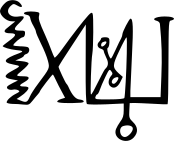
"The 44th spirit in order is named Shax, he is a great Marquize & appeareth in ye forme of a stock dove, speaking wth a hoarse & subtill voyce. his office is to take away ye sight, hearing & understanding of any man or woman at ye command of ye Exorcist, & to steal money out of kings houses & carry it againe in 1200 yeares, if commanded, he will fetch horses or any Thing at ye Request of ye Exorcist, but he must be commanded into a Triangle first or else he will deceive him, & tell you many lyes, he can discover all Things that are hidden & not kept by wicked spirits, he giveth good familiars sometimes, he governeth 30 Legions of spirits his seal is thus to be made, and worne as a Lamin &c."44. Shax

"The 63 spirit is called Andras, he is a great Marquiz appearing in ye forme of an angell wth a head like a Black night Raven, ridding upon a black strong woolf, wth a sharpe bright sword flourishing in his hand, his office is to sow discords, if ye Exorcist hath not a care he will kill him and his fellows, he governeth 30 Legions of spirits his seal is Thus, to be [made, and] worne as a Lamin before [thee] on you[r] Breast. "63. Andras
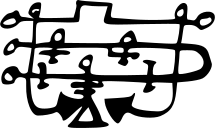
Of course, another aspect of the Ars Goetia is the perilousness of its rituals. This is already increasingly present in a lot of games, especially Nu-OSR titles. The danger posed however is very distinct. While TTRPGs commonly employ spell misfire tables, failure in the Ars Goetia often results in much more dire consequences as demons break loose from the control of their master.
A theme that will certainly prove recurring, is the astrological timing of magical ritual. Curiously, the text seems to be aware of this, and even accounts for it with the redundant nature of many spirits (e.g. There are countless demons for the study of the 7 artes liberales). Although an important detail historically, I doubt that most groups would find such limitations enjoyable per se.
Finally, the notion that practitioners must build relationships with the demons they frequently call upon might be interesting, particularly for Clerics (or other characters that acquire their abilities from higher powers). Building a smaller, base catalogue of spirits as a start shouldn't prove too hard, and would probably be enough for most campaigns. As with the Merkavah, discovering new sigils and coming in contact with further infernal beings can keep the magic system fresh, while also enriching the story.
Goetic rituals also aren't fit to replace regular spellcasting. They require intense preparations and elaborate ceremonies. Therefore, Goetia should be used for grander and more consequential effects. It's a form of magic that is slow, uncertain, and relational rather than mechanical.
Conclusion
The Ars Goetia presents an interpretation of magic that is very alien to the prevailing standard in role-playing games. It's not a system of spells, but a network of bargains and interest driven relationships. Power is not something a character innately possesses, but something they negotiate, extort and might losing. Adapting it for TTRPGs is not about adding new spells, but establishing a whole new kind of magic.